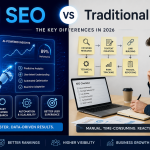

Search engine optimization has changed dramatically over the last few years. With the rise of AI-powered search experiences, businesses are asking an important question:
Is traditional SEO still effective, or should companies focus entirely on AI SEO?
The answer is not as simple as choosing one over the other. In 2026, businesses that achieve the best search visibility combine the strengths of both strategies.
AI-driven search engines, conversational search platforms, and generative AI tools are transforming how users discover information online. However, traditional SEO remains the foundation that helps websites get indexed, ranked, and trusted by search engines. Studies and industry reports consistently show that AI SEO works best when built on strong traditional SEO fundamentals.
In this guide, we’ll compare AI SEO and Traditional SEO, explore their strengths and limitations, and explain how businesses can build a winning search strategy in 2026.
What is Traditional SEO?
- What is Traditional SEO?
- What is AI SEO?
- AI SEO vs Traditional SEO: Key Differences
- Why Traditional SEO Still Matters in 2026
- Why AI SEO is Becoming Essential
- The Biggest SEO Mistakes Businesses Make in 2026
- The Best Strategy for 2026: Hybrid SEO
- How NMT Technologies Helps Businesses Win in AI Search
- Conclusion
- FAQs
Traditional SEO refers to the process of optimizing a website to improve rankings on search engines like Google and Bing.
Key components include:
- Keyword research
- On-page optimization
- Technical SEO
- Link building
- Content marketing
- Mobile optimization
- Website speed improvements
- Schema markup
The goal is simple:
Rank higher in search engine results pages (SERPs) and drive organic traffic.
Traditional SEO has been the backbone of digital marketing for over two decades and continues to play a critical role in online visibility.
What is AI SEO?
AI SEO (Artificial Intelligence SEO) is the process of optimizing content and websites for AI-powered search experiences such as:
- Google AI Overviews
- ChatGPT Search
- Gemini
- Perplexity AI
- AI-powered assistants
Rather than focusing solely on keyword rankings, AI SEO aims to increase the likelihood that AI systems will cite, summarize, and recommend your content when answering user questions.
AI SEO typically includes:
- Topic clustering
- Semantic optimization
- Conversational content
- Entity optimization
- Structured data implementation
- AI-friendly formatting
- Knowledge graph enhancement
- Brand authority building
The objective is to become a trusted source that AI engines reference when generating answers.
AI SEO vs Traditional SEO: Key Differences
| Factor | Traditional SEO | AI SEO |
|---|---|---|
| Primary Goal | Improve rankings in SERPs | Increase AI citations and mentions |
| Focus | Keywords and backlinks | Context, entities, and intent |
| Success Metric | Traffic and rankings | Visibility in AI-generated answers |
| Content Style | Keyword-focused | Conversational and intent-focused |
| Optimization Method | Search engine algorithms | AI retrieval and summarization systems |
| User Experience | Click-through traffic | Direct answers and citations |
| Content Structure | Pages and posts | Topic clusters and knowledge hubs |
Why Traditional SEO Still Matters in 2026
Despite the rise of AI search, traditional SEO is far from dead.
1. Technical SEO Remains Essential
Search engines and AI systems still need to:
- Crawl your website
- Understand your content
- Index your pages
Without proper technical SEO, even high-quality AI-optimized content may struggle to appear in search results.
2. Backlinks Continue to Build Authority
High-quality backlinks remain one of the strongest trust signals.
Authoritative websites linking to your content help establish credibility, which benefits both traditional rankings and AI visibility.
3. E-E-A-T is More Important Than Ever
Google continues to prioritize:
- Experience
- Expertise
- Authoritativeness
- Trustworthiness
Businesses that demonstrate genuine expertise outperform low-quality AI-generated content.
Why AI SEO is Becoming Essential
1. Search Behavior is Changing
Users increasingly ask conversational questions instead of typing short keywords.
For example:
Instead of:
“best cybersecurity company”
Users ask:
“Which cybersecurity company is best for small businesses in 2026?”
AI-powered platforms answer these questions directly. Businesses must optimize for these interactions.
2. AI Search Prioritizes Context
Modern AI systems focus on:
- User intent
- Topic relevance
- Content depth
- Brand credibility
Simply repeating keywords is no longer enough.
3. Brand Mentions Matter More
AI systems analyze information across:
- Websites
- Reviews
- Forums
- Social media
- Industry publications
Consistent brand visibility helps improve AI-generated recommendations.
The Biggest SEO Mistakes Businesses Make in 2026
Relying Only on AI Content
Publishing large amounts of generic AI-generated content without expertise often leads to poor performance.
Ignoring Technical SEO
Even excellent content fails if search engines cannot properly crawl and index the site.
Focusing Only on Rankings
Modern SEO success includes:
- AI citations
- Brand mentions
- Knowledge panel visibility
- Search authority
Neglecting User Experience
Slow websites, poor navigation, and weak mobile performance negatively impact both traditional and AI search visibility.
The Best Strategy for 2026: Hybrid SEO
The most successful businesses are not choosing between AI SEO and Traditional SEO.
They combine both.
Traditional SEO Foundation
- Technical optimization
- Keyword research
- Link building
- On-page SEO
- Core Web Vitals
AI SEO Layer
- Conversational content
- Topic clusters
- Structured data
- Entity optimization
- Brand authority building
- AI answer optimization
This hybrid approach maximizes visibility across Google Search, AI Overviews, ChatGPT, Gemini, and other AI-powered discovery platforms.
How NMT Technologies Helps Businesses Win in AI Search
At NMT Technologies, we help businesses future-proof their digital presence through:
- Advanced SEO strategies
- AI SEO optimization
- Technical SEO audits
- Content marketing
- Structured data implementation
- Website performance optimization
- Digital transformation services
Our approach combines proven SEO fundamentals with emerging AI search optimization techniques to help businesses increase visibility, authority, and long-term growth.
Conclusion
AI SEO is not replacing Traditional SEO.
Instead, AI SEO is expanding what SEO means in 2026.
Traditional SEO provides the technical foundation, authority, and discoverability that search engines require. AI SEO enhances that foundation by helping brands become visible in AI-generated answers and conversational search experiences.
Businesses that integrate both strategies will gain a competitive advantage, improve online visibility, and stay ahead as search continues to evolve.
The future belongs to companies that optimize for both search engines and AI-powered discovery platforms.
FAQs
1. What is the difference between AI SEO and Traditional SEO?
Traditional SEO focuses on improving rankings in search engine results, while AI SEO focuses on increasing visibility in AI-generated answers, AI Overviews, and conversational search platforms.
2. Is Traditional SEO still relevant in 2026?
Yes. Technical SEO, backlinks, content quality, and E-E-A-T remain critical ranking factors and provide the foundation for AI SEO success.
3. Can AI SEO replace Traditional SEO?
No. Industry experts widely agree that AI SEO complements traditional SEO rather than replacing it.
4. What are the benefits of AI SEO?
AI SEO helps businesses:
- Increase AI citations
- Improve brand visibility
- Reach conversational search users
- Optimize content for AI-powered search engines
5. What is Generative Engine Optimization (GEO)?
GEO is the practice of optimizing content so AI systems can easily retrieve, understand, and cite it when generating responses.